
















- 1
- 2
- 3
- 4
- 5
- next page
Chandeliers
A chandelier is a ceiling light. Its distinctive feature is that it is equipped with several light sources. These are usually circular and often arranged on several levels.
Characteristic of dazzling, pompous chandeliers are also hanging elements that serve to refract the light. You are certainly familiar with magnificent chandeliers hung with cut prisms of crystal from ceremonial halls, which define the room and attract attention with their sparkle and play of colour. However, a hanging is not a must and you will also find many simple models without.
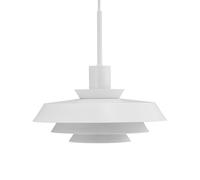
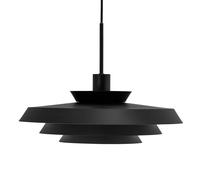
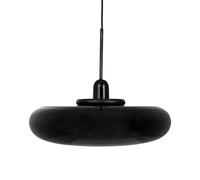
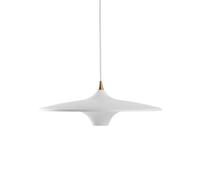
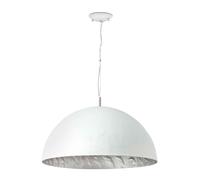
The pendant lights are available in many different designs - with hangings or without, in plain black or white. Accordingly, chandeliers also fit into the most diverse room designs.
Many people associate chandeliers with ostentatious, antique or baroque interiors.
With a chandelier with colorful sparkling hangings, however, you also set a stylish accent in modern rooms. It forms an appealing contrast to an otherwise rather straightforward and minimalist design.
Even in a rustic ambience, chandeliers do not necessarily look out of place. Designs in black without a lot of clutter look very robust and solid. This makes them a good match for wood and leather.
Simple chandeliers in white are a nice addition to a country style interior. Their various light sources create a cosy atmosphere.
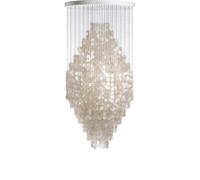
If you like it romantic, chandeliers with curved arms are a nice style element. Chandeliers with colourful pearl hangings spice up the room and are just the thing for you if you want your home to be a little more lively and playful.
Different materials are used in the production of chandeliers. You can find massive pendant lights made of iron, chrome, brass and gold-plated metals. These bring a corresponding weight.
Chandeliers made of glass provide the right sparkle effect. These are also not among the lightweights and are, as it is characteristic for the material, relatively sensitive.
Cheaper and lighter variants are made of acrylic or other plastics. A chandelier made of plastic is a good choice if you can foresee that collisions with the pendant light are not excluded. In addition, they are suitable for the bathroom.
Some chandeliers are equipped with lampshades made of textiles.
Due to the number and arrangement of light sources, chandeliers tend to be more expansive than other ceiling lights. Some have a considerable diameter of two meters. However, there are also much smaller models, with a diameter of only about 30 centimeters.
When choosing the size, it is not only crucial that the lamp somehow fits into the room. Especially since chandeliers are eye-catchers and, as pendant lights, reach far into the room, it is important that you adjust the diameter to the conditions in your home.
As a guide, there is a formula that you can use to determine the correct dimensions depending on the size of the room. To do this, add the length of the room in metres to the width in metres and multiply the sum by ten. The result is the appropriate diameter in centimetres. So if the room is three by three metres, the chandelier should have a maximum diameter of 90 centimetres.
This is in fact only a rough guide, ignoring, for example, the layout of the room. In addition, the formula refers ostensibly to square rooms.
Chandeliers from different manufacturers have different bases. When choosing a bulb, make sure that its thread matches the socket. For example, if your chandelier has an E14 socket, the illuminant must also have an E14 base.
If the socket matches, you can use the illuminant of your choice - light bulb, LED, halogen or energy-saving lamp. The different types of lamps have different properties. You can find out more about them in the guide to the illuminant category.
The shape of the suitable luminant depends on the design of the chandelier. The classic is a drop-shaped candle lamp.
How many watts or lumens the illuminant should have depends on how strongly the chandelier should illuminate the room. Both values indicate the brightness of the lamp - the higher the number, the brighter it shines.
When choosing the temperature of the light, your subjective feeling plays a decisive role.
The energy efficiency of a chandelier depends mainly on the illuminant used. Generally, LED lighting is the most energy-saving option.
The energy consumption of your chandelier is also determined by the number of light sources. Logically, the more light sources a chandelier has, the more electricity it will consume. Let this consideration factor into your decision and don't go by looks alone. Lower energy consumption is not only good for your wallet, but also for the environment.
Even before buying your chandelier, you should think about the mounting option. A crucial point is the interaction between the weight of the lamp and the load-bearing capacity of your ceiling.
Many of the decorative lights bring quite a few kilos. Concrete ceilings can usually cope with the weight. Old building ceilings, plasterboard ceilings, and covered ceilings hold less weight. If you choose a heavy chandelier, you need to make appropriate preparations, such as locating the ceiling joists or uncovering the raw ceiling.
Because of its weight, fixing a chandelier is not easy. It is therefore best to find someone who is willing to help you with your project.
In addition to helping hands, you will need the following utensils for hanging your chandelier:
- Ladder.
- Impact drill.
- Phase tester.
- Folding rule.
- Pencil.
- Screws / screw hooks.
- Dowel.
It is very important that you turn off the power before you start by turning off the fuse. Check whether the current flow is actually interrupted by pressing the light switch. You will know that you are right when the light does not come on.
Only then can you start to dismantle the previous light, provided it exists. Remove it from the luster terminal with a phase tester or a small screwdriver. Check the existing fixing possibility. If in doubt, insert a new plug and screw in a new screw hook.
Before you hang your new chandelier on it, shorten the chain to the desired length if necessary. You can usually bend the chain links open with pliers and remove them.
Now your helper comes into play. While he or she holds up the chandelier, you can conveniently connect it to the power supply by connecting its power cables to the chandelier clamp.
Then, hang the chandelier on the screw hook and screw it to the fixture.
Finally, switch on the fuse, check that the chandelier lights up when you press the light switch and enjoy the result of your work.
If the chandelier hangs freely in the room, you should ideally hang it so that it is two metres from the floor, so that taller people can also walk underneath it comfortably. If the ceiling height in your home does not allow for such a suspension, you can also go down to 1.80 meters - however, the chandelier should not hang lower.
If you place it above a dining table, the chandelier should ideally be about 75 centimetres from the tabletop. The height of a table is usually also 75 centimetres, so that measured from the floor it is about 1.50 metres high.
To unfold its full splendour, your chandelier also needs some distance from the ceiling. This should be about 30 to 50 centimetres so that its lighting effects can be fully appreciated. For very large chandeliers, it may be more. So choose a model with an appropriate chain length.
You can calculate the optimum chain length by subtracting the passage height from the room height and then subtracting the height of the chandelier itself. For example, if your room is 2.80 metres (2.80 m) high and you want to hang a chandelier that is 40 centimetres (40 cm) high and two metres (2 m) from the floor, the chain should be 40 centimetres (40 cm) long (2.80 m - 2 m - 40 cm = 40 cm).
Dimmers are available in various designs. You will find rotary, rocker and pushbutton switches as well as variants for the smart home. When choosing the right dimmer, however, it is not primarily the type of operation that matters.
First of all, you need to find the version that is compatible with the illuminants used. Dimmers differ by their technology. There are leading-edge and trailing-edge phase dimmers. While the brightness of LEDs, halogen as well as incandescent lamps can often be regulated with both dimmer technologies, energy-saving lamps usually require a leading-edge phase dimmer. There are also lamps that are not dimmable. Inform yourself in advance about the properties and requirements of the illuminant.
It is also important that the brightness regulator has the right power in watts. This must correspond to the power of the chandelier as a whole, that is, the sum of the power of all sockets in which you insert the individual bulbs.
Dust your chandelier at least once a month so that the lint doesn't take away from its splendor. The best way to do this is to use a feather duster. You can also blow the dust flakes away with a hair dryer.
If your chandelier is made of acrylic, cleaning it with a dry cloth is not a good idea. This is because the material becomes statically charged. Instead of ridding the chandelier of dust, you'll only make it more attractive to it.
To make sure that your chandelier doesn't degenerate into a sparkle, you should also give it a good clean about once a year. This is where moisture comes into play. That's why the first step is to switch off the power.
There are several ways to clean the column, the arms, the bowls and the hanging:
- Chandelier cleaning spray: You spray your chandelier completely with the special cleaning agent and let it drip off. For this reason, it is important that you cover the floor under the chandelier with towels beforehand. Wipe off any areas where the cleaner collects with a cloth. Otherwise, just wait for the spray to dry completely and then turn the power back on. Cleaning with a spray is wonderfully easy, but streaks can occur and it is the most expensive option in comparison.
- Glass cleaner: Glass cleaner is of course only suitable if your chandelier or its hangings are also made of glass. You spray the corresponding parts with it and then wipe them dry with a microfiber cloth.
- Home remedy: You don't necessarily need a special cleaner to make your chandelier shine. You can also achieve this result by mixing a little mild washing-up liquid or shampoo with water and adding a splash of vinegar. Pour the mixture onto a cloth and wipe the chandelier with it.
How well did the information meet your expectations and assist you further?
 Not at all

 Neutral

 Very much